// org: IIT Jammu · SPARC Lab · Dr. Sudhakar Modem · RISE UP Batch 2026
BMS Design — Battery Specification & IC Selection: The primary deliverable was a complete BMS hardware design for the leg of a humanoid robot. Work began with power requirement analysis: the leg assembly comprises four brushless motors (2× hip, 1× knee, 1× ankle) using the EB6220 150KV BLDC, operating at 48V and drawing up to 60A continuous. Battery chemistry was evaluated across Li-ion, LiPo, and LFP options; Li-ion was selected for its superior energy density and discharge performance at sustained loads. Cell count was derived from the voltage requirement — 12S at 4.2V/cell gives a nominal 44.4V pack. The selected battery is the GENX PRO+ 12S 30Ah solid-state Li-ion pack.
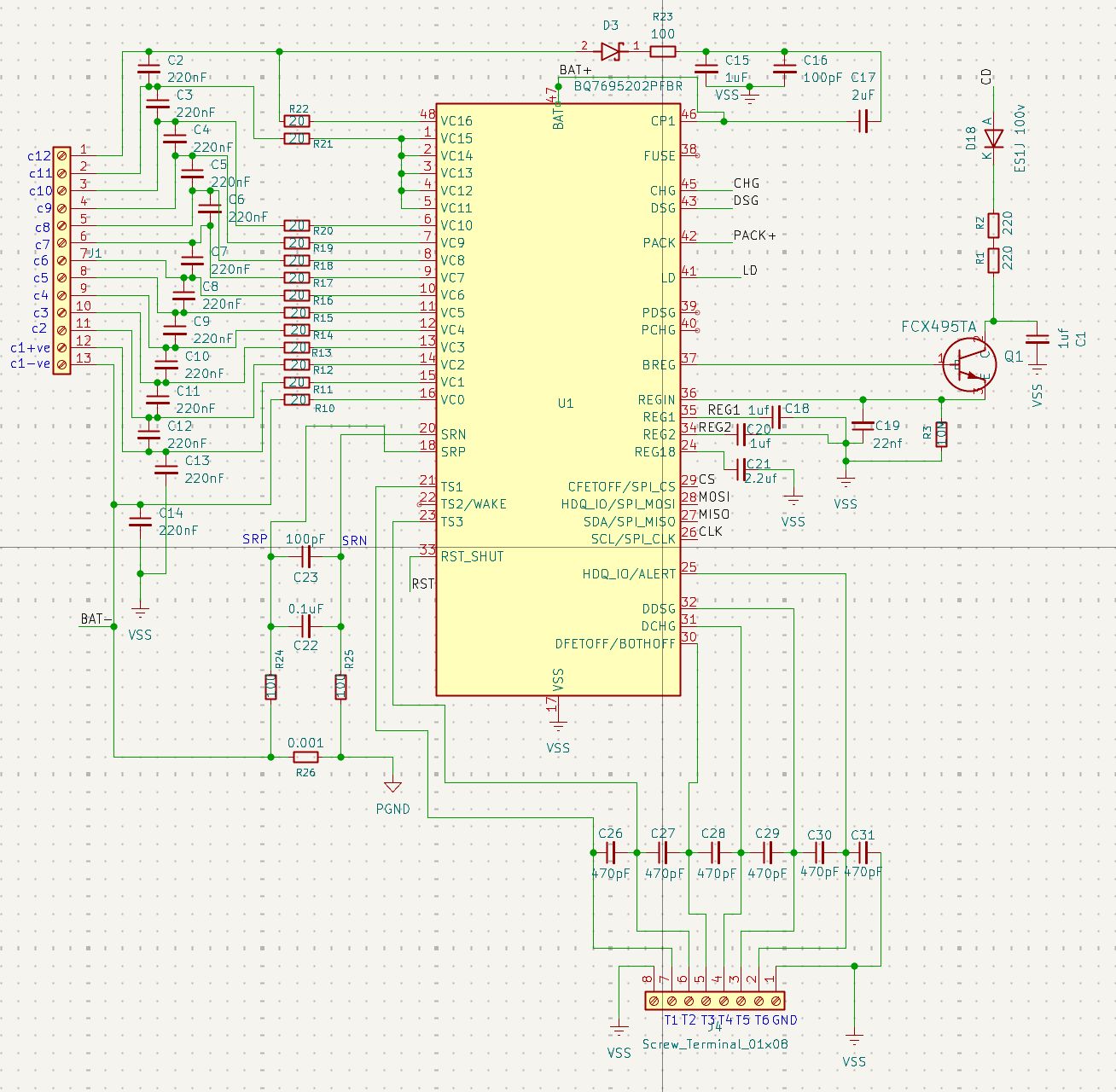
BMS IC Selection & Schematic Design: BMS ICs from Texas Instruments (BQ76952 series) and Analog Devices (ADBMS6822, ADBMS6830B) were compared across protection features, balancing capability, communication interfaces, and availability of application literature. The BQ7695202PFBR was selected for its 16S-capable architecture, integrated charge pump for high-side NFET gate drive, built-in passive cell balancing, coulomb counting with dual digital filters, and nine NTC thermistor inputs for thermal monitoring. The schematic was designed around this IC: 12S cell tap inputs with RC filters (20Ω + 220nF per cell), a 1mΩ shunt resistor for current sensing, SPI communication pins, LDO circuit for external peripherals, and 6 thermistor inputs for pack-level thermal management.
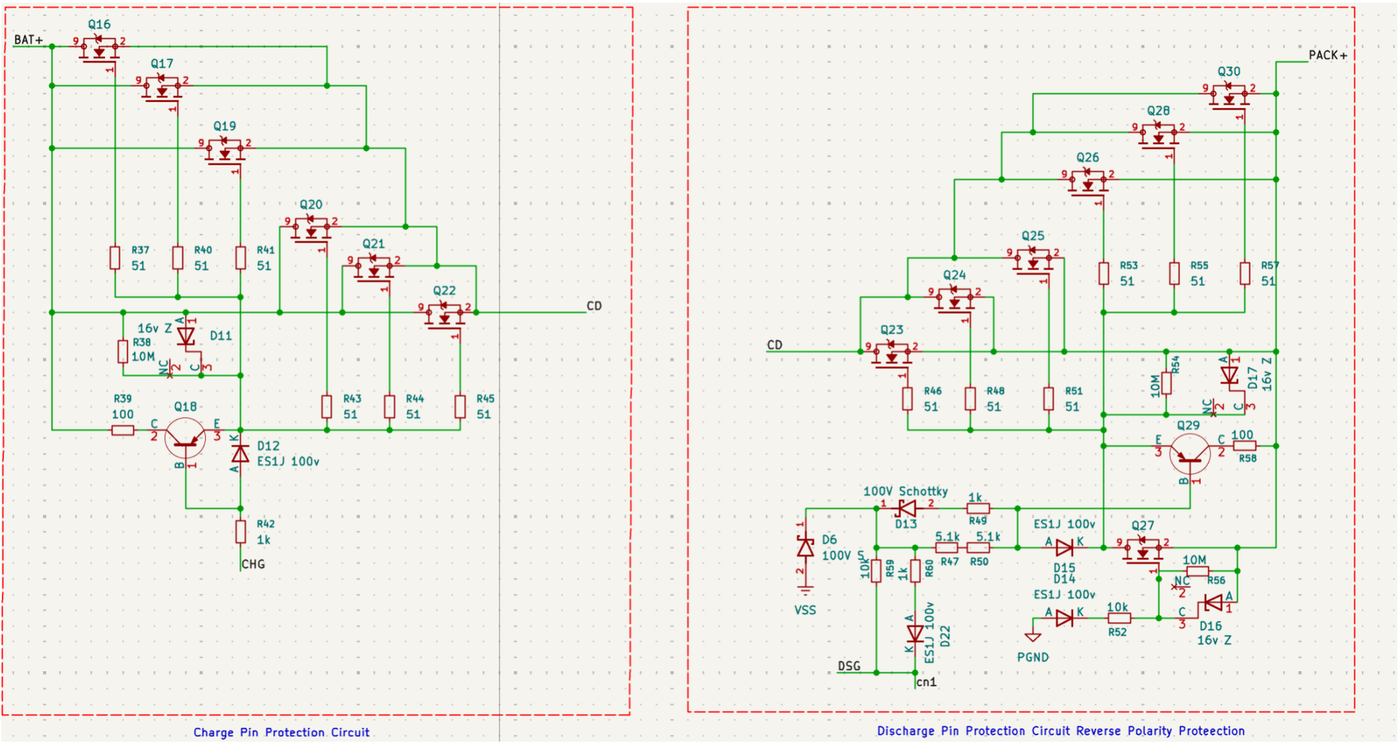
Protection Circuit: A 12-MOSFET high-side protection stack was designed across the CHG and DSG paths using the IAUS300N08S5N012 (6 per path), providing overvoltage, undervoltage, overcurrent during charge and discharge, short-circuit protection, and reverse polarity protection. Gate-assist circuitry uses the MMBT5401 PNP transistor; the FCX495TA NPN handles BREG preregulation. The full CHG and DSG protection sub-schematics were completed and reviewed against the TI application reference.
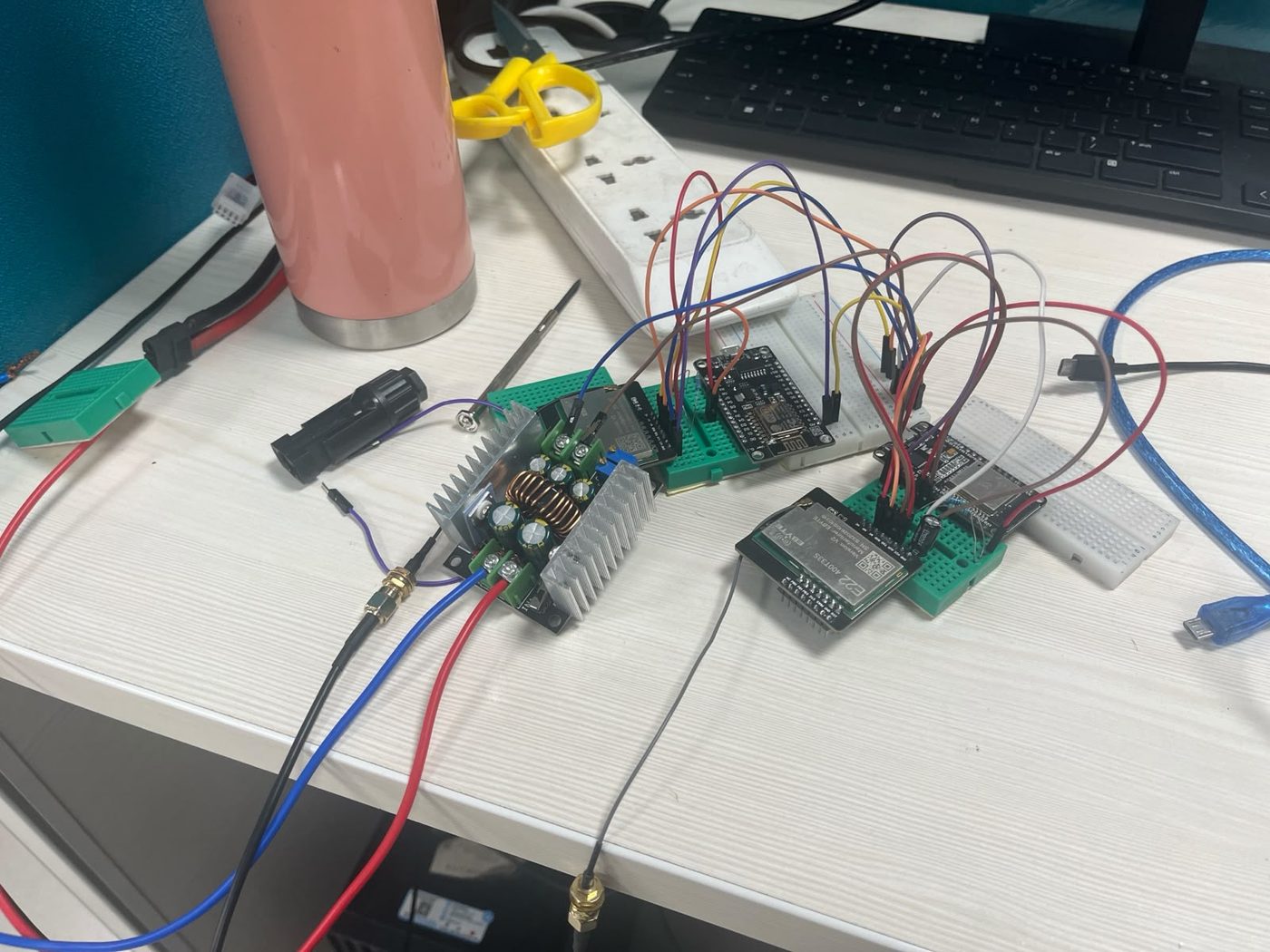
LoRa Communication — Hands-On Hardware Work: Alongside the BMS design, practical communication work was conducted using two Ebyte E22-400T33S LoRa modules to establish a wireless link between two ESP32 microcontrollers. The system was powered by a drone battery stepped down through a buck converter to provide stable regulated voltage and sufficient current to both nodes. This covered module initialisation, SPI configuration, packet transmission, and validating reception at range — providing practical exposure to RF hardware bring-up outside the schematic domain.